Options Expiration and other landmines

Posted by downtowntrader | 10/19/2006 08:59:00 AM | 3 comments »

Muuad posted a good question in the comments section that I thought deserved a post.

Here is the question:

Here is a question thats been popping in my mind lately, and seeing as you have mentioned it a few times... Are there certain dates that "the fundamentals" take over, or other events that create difficulty (e.g. Options Expirations), and technical traders would do best to stay out of the markets? For example, Earnings (in general or for specific companies currently traded), FOMC meetings, Economic data reports, Options Expirations, etc.

What recommendation would you make to technical based traders to keep on their "Economic Calendar" as days better spent away from the trading desk?


The short answer is, it all depends on what type of trader you are.

Let's tackle options expiration first. If you are a position or intermediate term trader, then there is not much you can do about trading options expiration. They key idea to take, is that prices will deviate on options expiration, as options related noise is amplified. While some is overt manipulation, most of it is natural, due to the fact that most option holders will get out of option positions rather then exercise them. This has a natural tendency to "pin" a stock to a specific price with a high open interest. It is my belief that a lot of institutions also program trade in order to protect certain positions with large exposure to them, via calls or puts written. So how do you navigate this period?
  • Daytrading is generally quite difficult because of how complicated some of the options ramifications can be.
  • I don't initiate swing positions in the couple of days leading to expiration beacuse of pinning and or counter moves the following week.
  • I check the max pain level for open positions. If you are unfamiliar with the Max pain theory it is better explained by this program written to calculate Maximum Pain.
  • I will hold positions that are doing well, as long as Max pain above is not in direct opposition with my position.

For my style of trading, earnings are a no no. It is too much of a risk to try and predict which way things will shake out. Sometimes you may be right on earnings, but management will kill you with guidance. Other times the street was looking for something different and the stock will move violently in the opposite direction. I am not a fundamental investor, and trying to estimate earnings is not my edge. As a swingtrader, I am using fairly tight stop levels in order to increase exposure. Subjecting these type of trades to earnings is like playing russian roulette. Eventually you will have a disastrous gap go against you.
Intermediate term or position traders are playing for longer moves with much wider stop levels, so earnings may or may not be acceptable risks. Again, this totally depends on what you are trying to accomplish with the trade.

As far as other events, it all depends. Fed days are usually pretty crazy intraday. The past few fed days have been fairly benign, but some of the last Bernanke days where nuts. I would say that daytrading is not recommended as the mornings are fairly muted, and the afternoon is littered with countermoves. I typically will hold off on entering swings that day and possibly the day before due to the potential for an over reaction. I typically try to stay aware of other reports such as oil inventories, but prefer to ignore them mostly.

The most important thing about Earnings and news reports is to not get caught in trying to figure out what the implications are for each report. Let the markets decide and pay attention to the reaction. It doesn't matter if you have it right or not, what matters is how the markets react.

Hopefully this helps.

DT

Lessons Learned

Posted by downtowntrader | 10/18/2006 09:26:00 PM | 3 comments »

Since I will be sticking to my rules :) and not trading the next two days due to options expiration, I decided it would be a good time to review a few trades. I haven't done this on the blog before, and hopefully I can help some of you become better traders by learning from my mistakes. Let me know what you think.

I actually felt a little better about today's highway robbery after seeing the next two charts. Both of these are where stops saved me from virtual disasters.


Illumina, Inc. (Public, NASDAQ:ILMN)

Let's start with ILMN. I had a decent looking long trade in ILMN in late September but it abruptly reversed after breaking out to a 52 week high. I was able to make a little money as I was aggressive in locking in profits. It really pulled back hard eventually breaking a long term trendline. It then retraced up the trendline observing it as resistance. It started to narrow in range and volume was pathetic. I shorted on a wide range day that took out the previous daily low. I booked a little profits the following day because the general markets were rallying very strongly. But as it climbed near my stop, I added more to my lot. I was stopped out two days later in the high 35's.

So what did I learn? I think I had a good thought process here, and you can't win all your trades. My biggest error was in adding more shares to my lot as it got closer to my stop. I didn't move my stop, but adding shares ate up the little profits I booked. Thankfully, my stop prevented me from today's 20% gap up.

Intervest Bancshares Corp (Public, NASDAQ:IBCA)

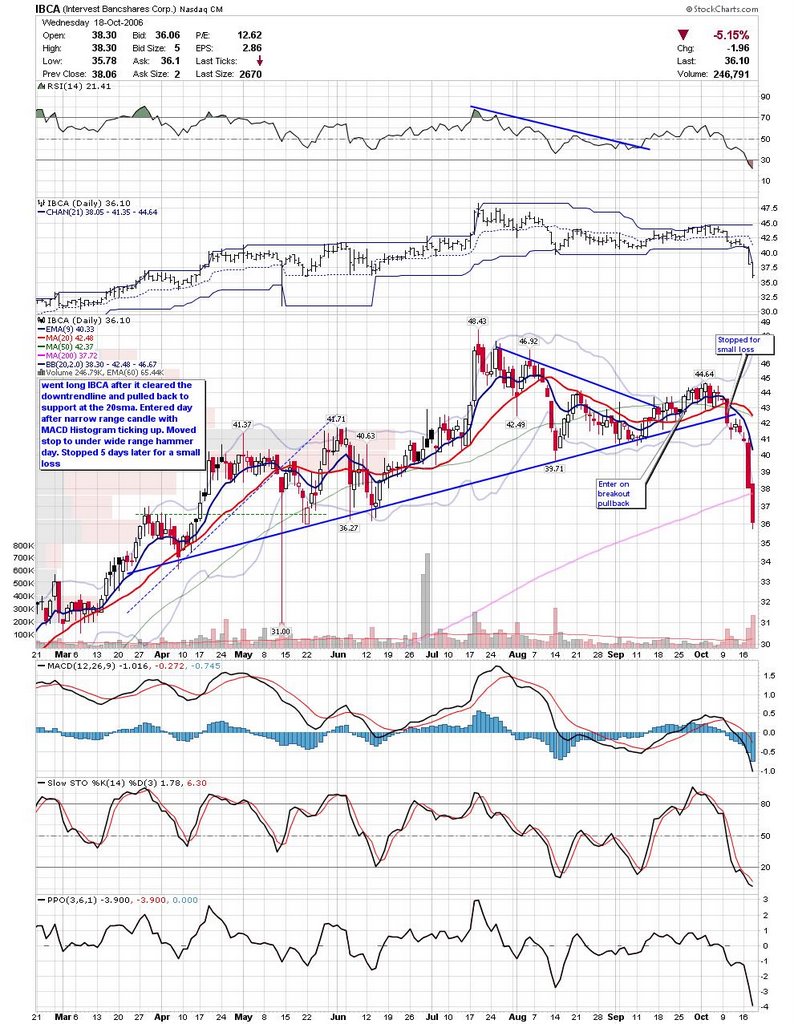
Next on the list is IBCA. I entered IBCA after it pulled back from breaking the downtrendline of a breakout pullback. I waited for it to come back to support. After a narrow range candle formed, I decided to enter if it made the higher daily high. The trade immediately went in my direction but didn't really make the expected move. It continued to trade sideways, and I added to my position as it dipped. It eventually petered out and stopped me for a small loss. Again, very lucky as it fell apart a week later.

What did I learn? I think I should start thinking about putting in a time stop for trades that don't move. Also, this stock was too thin and I kept worrying about the large spreads. Another mistake was not taking some profits as it kissed the upper price channel at 44.64.

Diodes Incorporated (Public, NASDAQ:DIOD)

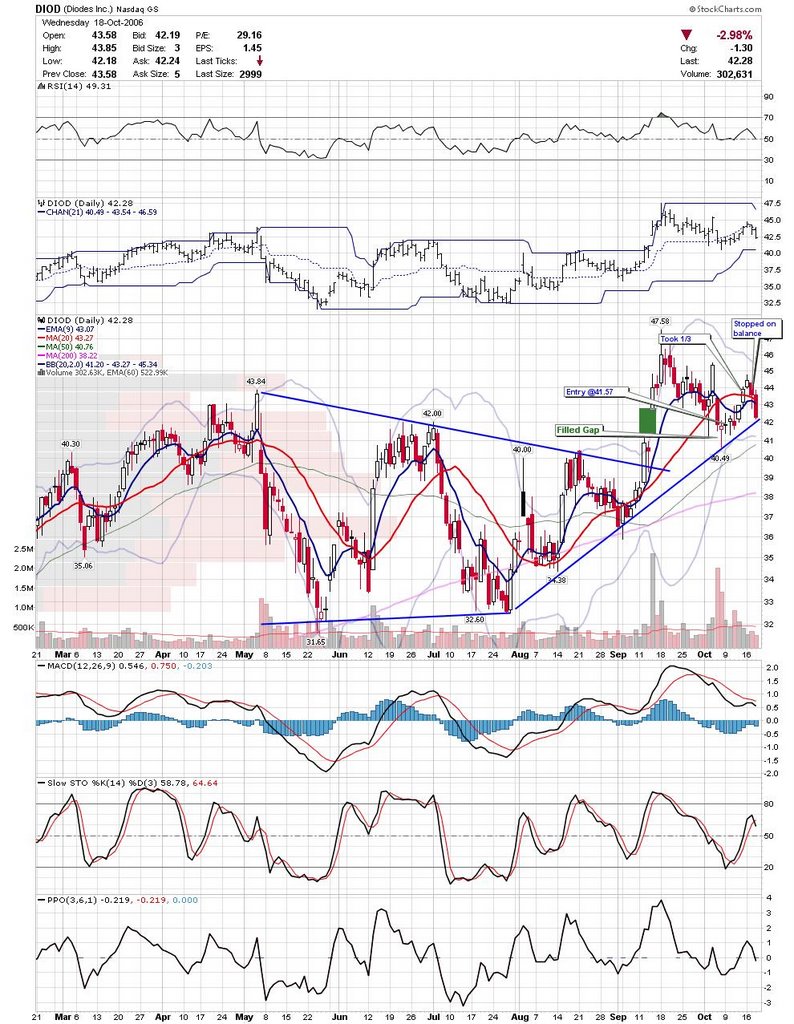
Here is a decent trade in DIOD. I was looking for a semiconductor stock, expecting strength in the sector. DIOD had the potential for an explosive move so I looked for a good entry. I waited for them to pull into the gap and when they filled it they ended in a hammer. I bought the next day as it dipped into the hammers body. This trade went nowhere for a few days but then had a little move up. I chose to show this trade, not because I made a ton, but because I didn't fool myself into sticking around longer then I should of. I made more in FLSH and NVDA but this was a better learning experience. I raised my stop and locked in a solid gain.

What did I learn? I learn more from my losses then my winners, but one lesson that I reinforced was that it's usually best to wait for the C of an ABC correction. I find myself getting in early too often and I was rewarded for being patient here.


VAALCO Energy, Inc. (Public, NYSE:EGY)

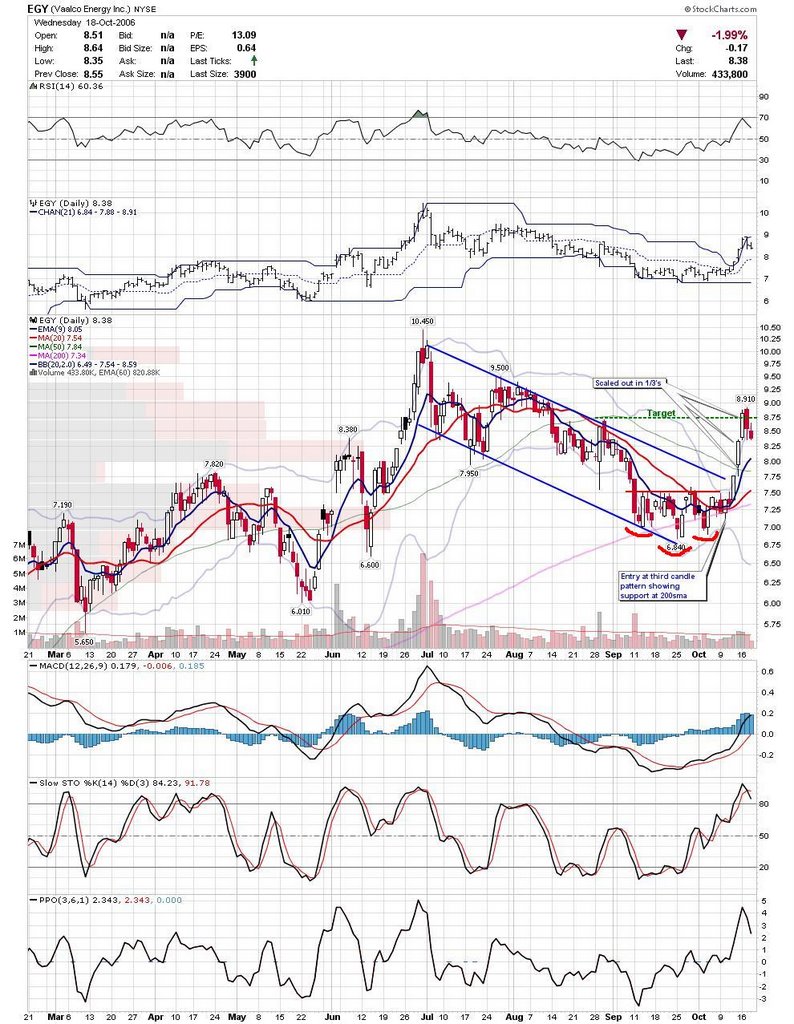
The last trade I will show tonight was a very nice one for me. I was looking for a short covering move in the Oil / Oil services sector and EGY was one of the stocks that held up through the correction in that sector. I was more interested in how Candlesticks were showing support at the 200sma. If you look at the three candlesticks highlighted on the chart you will also notice that ended up forming a small reverse head and shoulders. One of the most important things about candles that beginners miss, is that where certain patterns form, is infinitely more important then what candle is formed. Three bullish engulfing patterns at the 200sma was a clear signal that someone was buying there. I entered as EGY reversed intraday the next trip to the 200. It completed the reverse H&S and had a three day breakout. I took a little off and finally closed it on the third day as it reached the previous pivot high. Another thing I do, is try to not get carried away with a parabolic move. The market has a funny relationship with the number 3 and If I get three strong up days, I almost always take my money and run. This looks like it will move again after it breathes a little.


So what did I learn? Well, I didn't really learn this, but it reinforced the idea that when a stock moves in synch with it's sector, the moves are much more powerful.

So there you have it. Four trades, two winners and two losers. They key to these was that I cut the losers pretty short, and tried to squeeze what I could out of my winners. While some of you would trade these completely differently, I tried to be true to my methodology and stuck with my strengths.

I have a quick thought on the markets. Notice that the QQQQ has left a gap in the chart and has had two days of selling on increased volume. That gap will serve as resistance and will become stronger the longer it goes unfilled. Also, yesterday was more bullish in how it closed, but markets that gap higher and close near lows are signs that the bears are gaining control. Tops take time to form, but be warned that the market may be giving us a clue here.

Good Luck,
DT

Talk about bad luck

Posted by downtowntrader | 10/18/2006 04:58:00 PM | 5 comments »

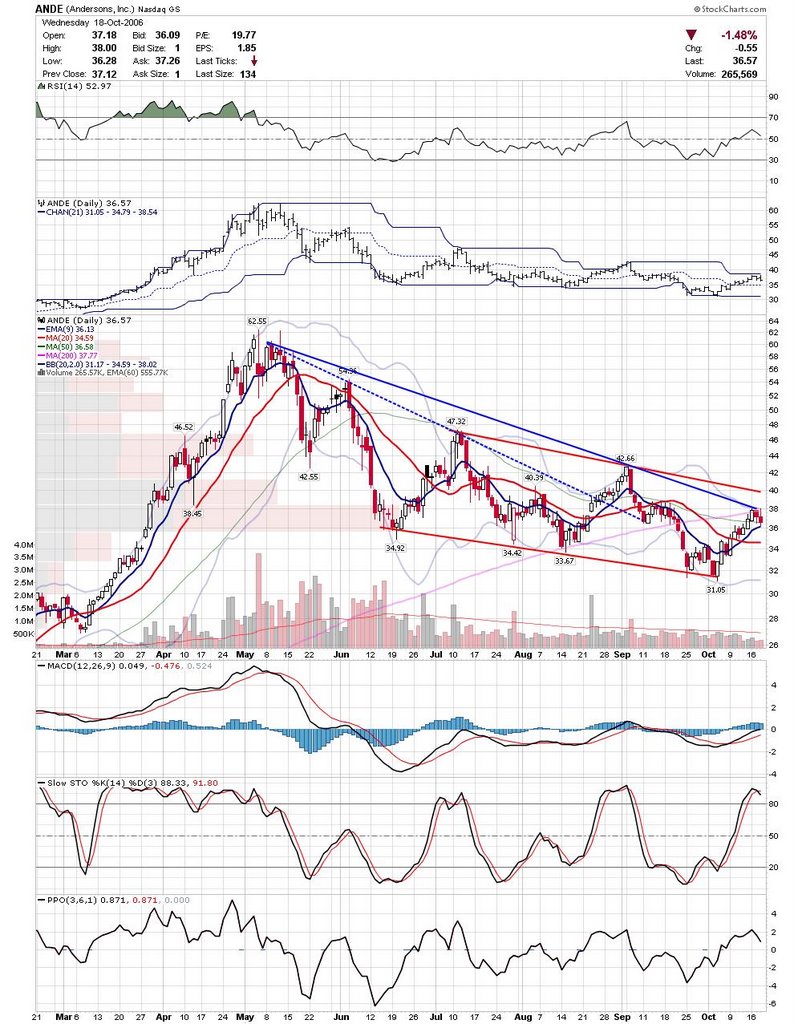
I don't subscribe to conspiracy theories about market makers out there trying to screw people over (even though some would in a heart beat). They are out there fighting other MM's so it's not that easy to manipulate things. But sometimes things just burn me up. I had to post this trade just to get it out of my head, sort of a poker style, bad beat story. I shorted ANDE as a swing trade. Lower low on daily, reversing off upper band, Stochastics crossover, yada yada yada.

Things were moving along nicely when all of a sudden price spikes up from 36.28 - 38.00 in 15-20 seconds.


That is almost 2 bucks, then reverses back on the same bar. Of course, my alert was triggered at 37.11, but even worse, I was filled at 37.50. So I went from a .5R gain to a 1.5R loss in 20 seconds. Which would be fine if I got caught in a squeeze, but the price returned to normal in 20 seconds. I could even understand price gravitating towards lined up stops, but this was at the low of the day. It's amazing that this stuff happens, but it does.

Is there a lesson learned? Not sure. Maybe stick to higher volume stocks, but this isn't too low of a floater. I know some may say don't place hard stops, but I use alerts, so they are hidden. I don't use mental stops, because I prefer to have my alerts in place in case I am away for any reason. You can't predict sudden news, so I prefer to have my stops in advance.

So here I am angrily watching as AAPL, CTXS, EBAY, etc are moving around after hours and evil thoughts are creeping in my head to make up those 1.5 R's. This is the real lesson. I need to walk away and forget about exacting revenge.

See you tonight.


DT

The most important question

Posted by downtowntrader | 10/17/2006 09:04:00 PM | 0 comments »

Michelle B. had a great post today over at TraderMike's site regarding discipline and how a trader can get trapped in a vicious cycle of breaking their own rules and "fall victim to a trap of his own making". It is extremely important to be cognizant of when discipline problems are creeping into any part of our lives, as lack of discipline has a way of breeding itself into the vicious cycle described by Michelle. Whether it's the slice of pie when you're on a diet, or that stop you pulled this morning when the markets gapped lower, it is important to realize that eventually undisciplined actions have a chance of snowballing into wrecking machines.

She also pointed out how rules should be few and simple. Complex and detailed rules can help the beginning trader from making some obvious mistakes, but eventually, a trader needs a little freedom and discretion and an over abundance of rules will hamper the trader. She whittled it down to one rule. "Execute perceived opportunity according to my risk parameters". Pretty simple, but what she is basically saying, is FOLLOW MY TRADING METHODOLOGY!!! Read the post when you get a chance as it shows that Michelle is a seasoned trader writing from experience.

I have a similar rule, that I turn into a question I ask before every trade I make.

Do I have an edge?

Thats it. If it's yes, then I take the trade. No, and I look elsewhere.

So what is an edge? An edge is not that your buddy went to the Apple store and had to wait in line for 30 minutes. Nor is it the rumor you saw on the message board posted by Apple_Insider_2008 saying that a new ipod will be released with a bluetooth surround sound system. An edge is a strategy or method that has been tested to give you a positive expectancy over a large sample of trades. In other words,

  1. you either win more times then you lose
  2. win more money when you win, then lose money when you lose
  3. or both.
The second is easier then the first, and the first comes with experience as a trader becomes more selective with a refined edge. I have non trader friends that are shocked when I explain that you can make a very good living losing 60% of the time. The key is to cut your losses and maximize your gains. While it is important to have guidelines for different phases of a trading methodology, the bottom line is a trader needs to ask just one question before taking a trade. Do I have an edge?

If the answer is I'm not sure, then either the trader doesn't have a clear methodology, or the trade is questionable and should be let go.

The markets finally showed some weakness today, and look like they will have another wave down on the 60 minute charts. I don't think it's time to short yet, but I'm not crazy about going long with Options expiration approaching towards the end of the week. I may just wait till next week before putting on any trades.

Good Luck,

DT

How I use my charts

Posted by downtowntrader | 10/16/2006 06:01:00 PM | | 5 comments »

The markets had another decent move today with the DJIA just missing the 12K mark. While 12K doesn't really mean much, don't underestimate the power of big whole numbers and crowd psychology. Rather then post charts tonight, I figured I would change it up and post on how I use my charts.

Some of you may have noticed that I have changed my charts around recently. I have been tinkering around with my swing trading strategies in order to streamline them recently, and the result was removing some indicators from the charts, and changing things around a bit. Before I go through the charts, I would like to define the type of trader I am, as it should provide insight into why I post certain types of charts on my watchlist and not others.

I am a swing trader with an average hold time of 1-4 days. Most trades are closed in about 2.5 days. While I do hold longer in certain instances, I'm usually playing for one leg up or down. I have experimented with different time periods in the past, and I've found that when I try and hold for longer periods, I tend to get chopped on the pullbacks with my stops. I like to buy near a value area and sell on the breakout moves. I've tried breakout/breakdown trading and find that I get larger wins, but a lower success rate. I still trade breakouts if the setup is perfect though, but it is not my typical play. I also daytrade a gap momentum strategy, but we'll leave that for another post, as my bread and butter is the swing trade.

I call the strategy I use most, a breakout pullback, as I look for a stock that just made a pivot high and pulls back to support. My preference is for a breakout from a chart pattern followed by a pullback to retest the breakout area. The support can be a trendline, bollinger band, previous candle pattern or moving average support. I try to wait for confirmation that support is being respected and then jump on board as soon as it starts to move up. I try and get an entry close to support, so that not if, but when I'm wrong, it only costs me a small amount. I then sell at least a third when it starts to move towards my initial target to lock in a gain.

I decided to stick to the following indicators and discarded the rest.

  • Price and Volume: Everything is a derivative of these two and therefore they are the most important
  • Moving Averages: I use a few moving averages, but focus on the 9ema and 20sma for most of my trading decisions. I keep an eye on the 50 and 200sma's as institutions favor those.
  • MACD: I use the MACD for divergences and for screening my decisions. I like for Histogram to tick in the direction of my trade before making the entry. This stops me from catching a falling knife.
  • Bollinger bands: I like when trendlines and moving averages converge on a bollinger band sloping in the direction of my trade. I love when I get a double bottom on a BB.
  • Price Channel: I use the price channel on a separate window to keep me honest at entering near value and when it is expensive.
  • Stochastics: I like to use Slow stochastics as an additional confirmation and prefer to have it trend in the direction I am taking.
  • PPO: I use a simple PPO to illustrate 3 and 6ma crossovers. It is simply used to warn me if I stay in a stock too long.
  • RSI: I use RSI to spot divergences and to show overbought and oversold readings.

I don't use any indicator as a mechanical trigger. I only use them to provide clues and confirmations of price and volume. Beyond the above, I look to the weekly chart to screen my trades. I prefer the weekly to be in order and for either the 10sma to be ticking up or the MACD histogram to be ticking up. This is similar to Alexander Elders Impulse system for those familiar with it. I then look to the daily and use the 9 and MACD histogram in the same way. This is just another mechanism that forces me to be objective about any chart.

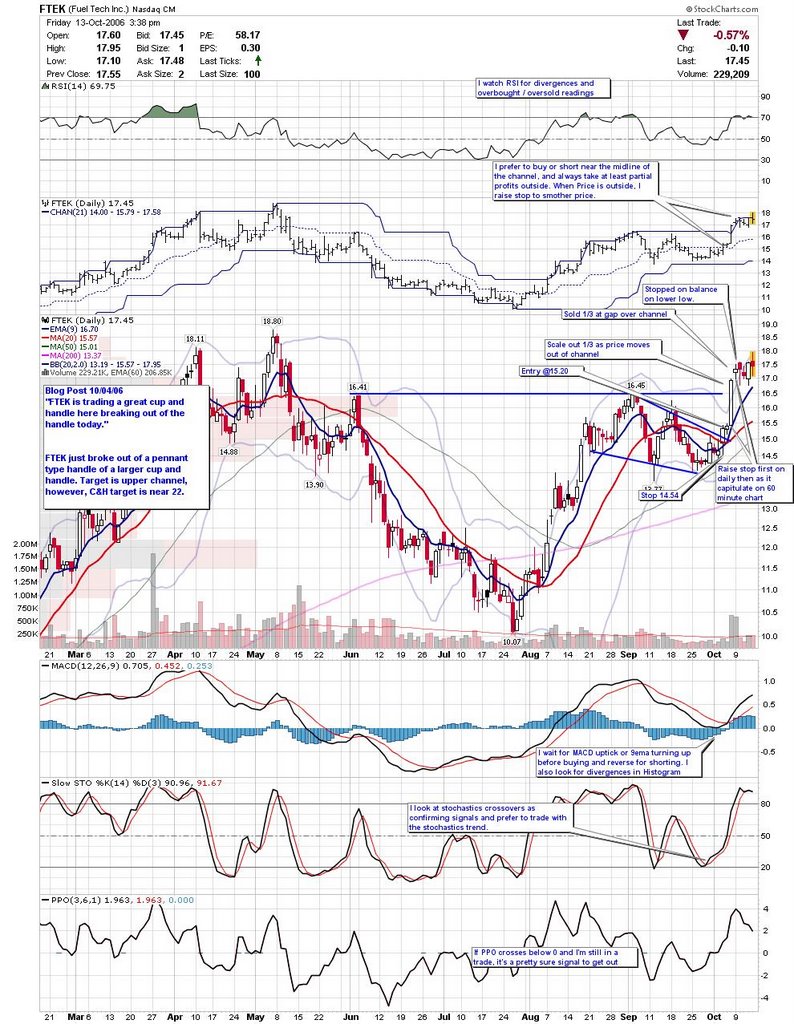
Here is a chart of a trade I recently took with some of the reasoning behind the trade. By the way, I have charts like this for most of my trades. I use them to analyze the thousands of mistakes I make and to note any improvements I could of made. It's amazing how much you can learn pouring over your mistakes.


Fuel Tech Inc. (Public, NASDAQ:FTEK)

Click on the chart to zoom.


This setup is more of a general idea that has a few variances. There are pullbacks after 52weekhighs, pullbacks after a downtrend breakout, and mid-trend pullbacks, with each having different indicators I watch more closely. For instance, on a downtrend breakout, I like to see a little double bottom on the bollinger band. On 52week high stocks, I look more closely at RSI divergences. The key here, is to have a plan for your setups and then to stick to your trading methodology. After much trial and error, I have found this to be MY most reliable setup. I really improved as a Trader once I defined what I was trying to do, and threw out the rest. I think it's important to note that what works for me may not be what works best for anyone else. Every successful trader I know has a bread and butter setup they use that has been tweaked to their personality through years of trial and error. My suggestion to those struggling with trading is to focus on one setup, and start paper trading it. If it seems like something that agrees with your own unique trading persona, then try it exclusively for a few months in the real world.


Also, keep in mind that the trading strategy is only one part of a trading plan. Money Management is still by far the most important piece of the puzzle, but also the least exciting to write about ;) . If I rambled too much, or was unclear on something, please feel free to respond in the comments section.

DT

Options Expiration Week

Posted by downtowntrader | 10/15/2006 10:42:00 PM | , , , , , , , , | 0 comments »

This week is options expiration week, and should be interesting with the markets as extended as they are. Although it's probably a little late to be buying this rally too agressively, there is no topping pattern present yet, so I'm not going crazy looking for shorts either. Here are a few charts I will be watching this week.


Citrix Systems, Inc. (Public, NASDAQ:CTXS)
CTXS is one of the few charts I've seen that is near value and not too extended for an entry.


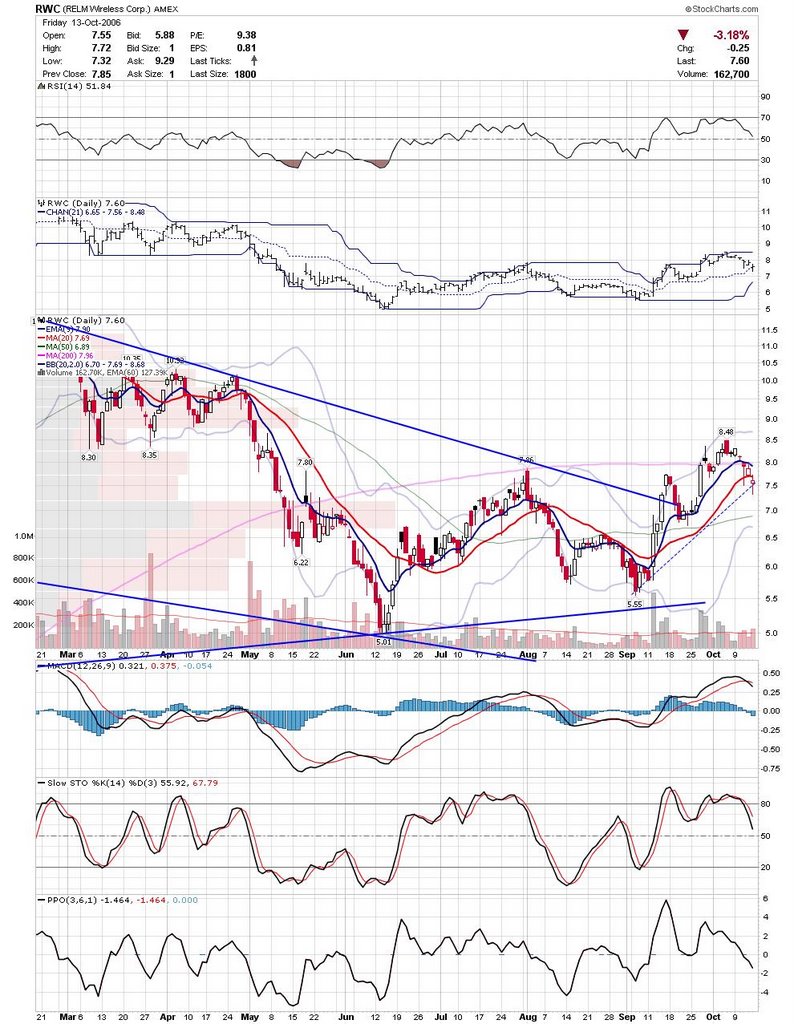
RELM Wireless Corporation (Public, AMEX:RWC)
RWC has pulled back after breaking the downtrend. It may firm up here finding support at the breakout candle.

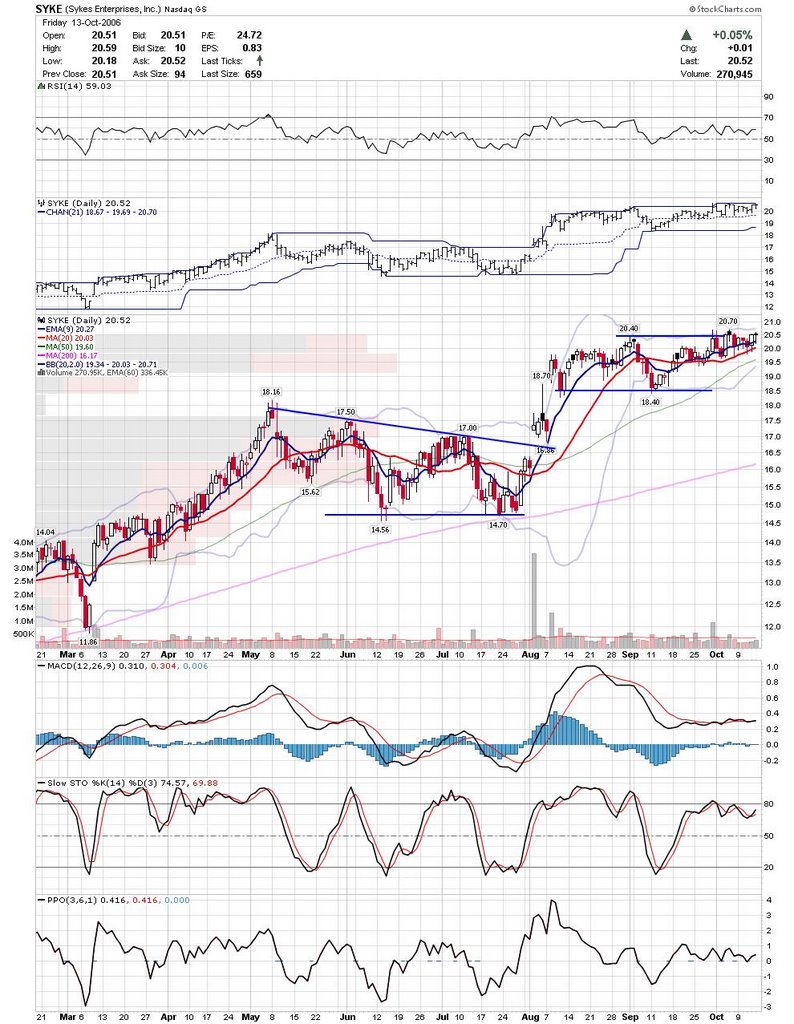
Sykes Enterprises, Incorporated (Public, NASDAQ:SYKE)
SYKE continues to trade a very tight range near a breakout area.

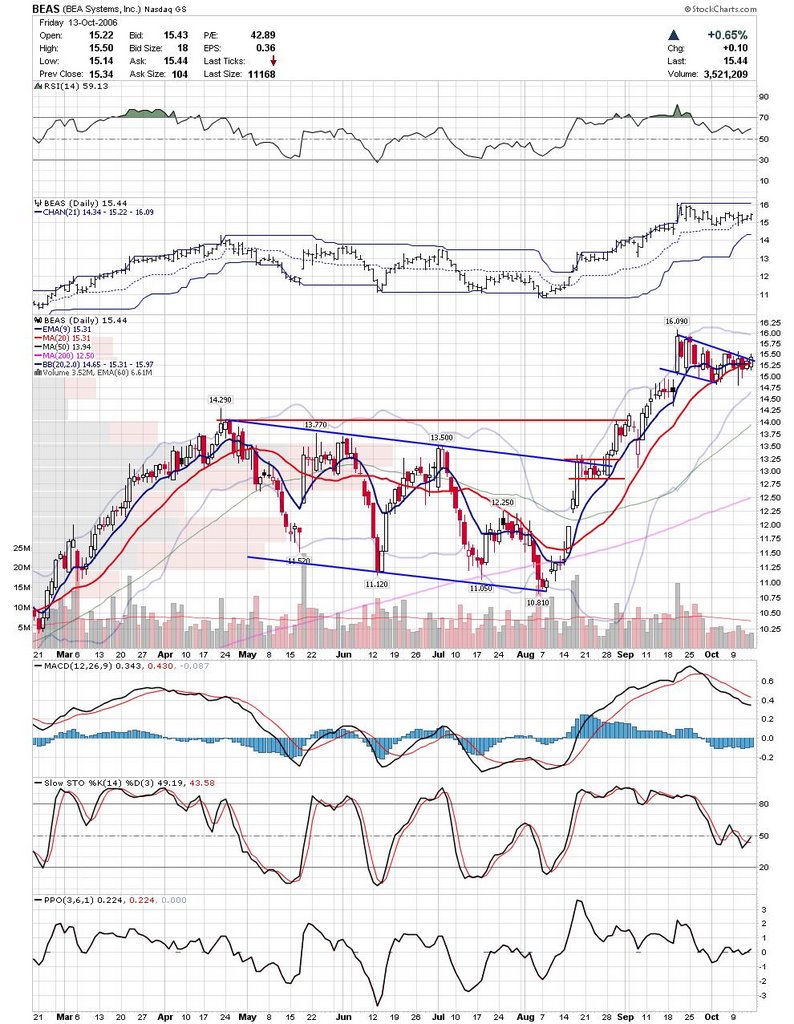
BEA Systems, Inc. (Public, NASDAQ:BEAS)
BEAS looks like it is clearing the bull flag consolidation pattern here.

Piper Jaffray Companies (Public, NYSE:PJC)
PJC is near clearing a much sloppier bull flag then the BEAS flag. It still offers a decent risk reward though with the narrow range candles.

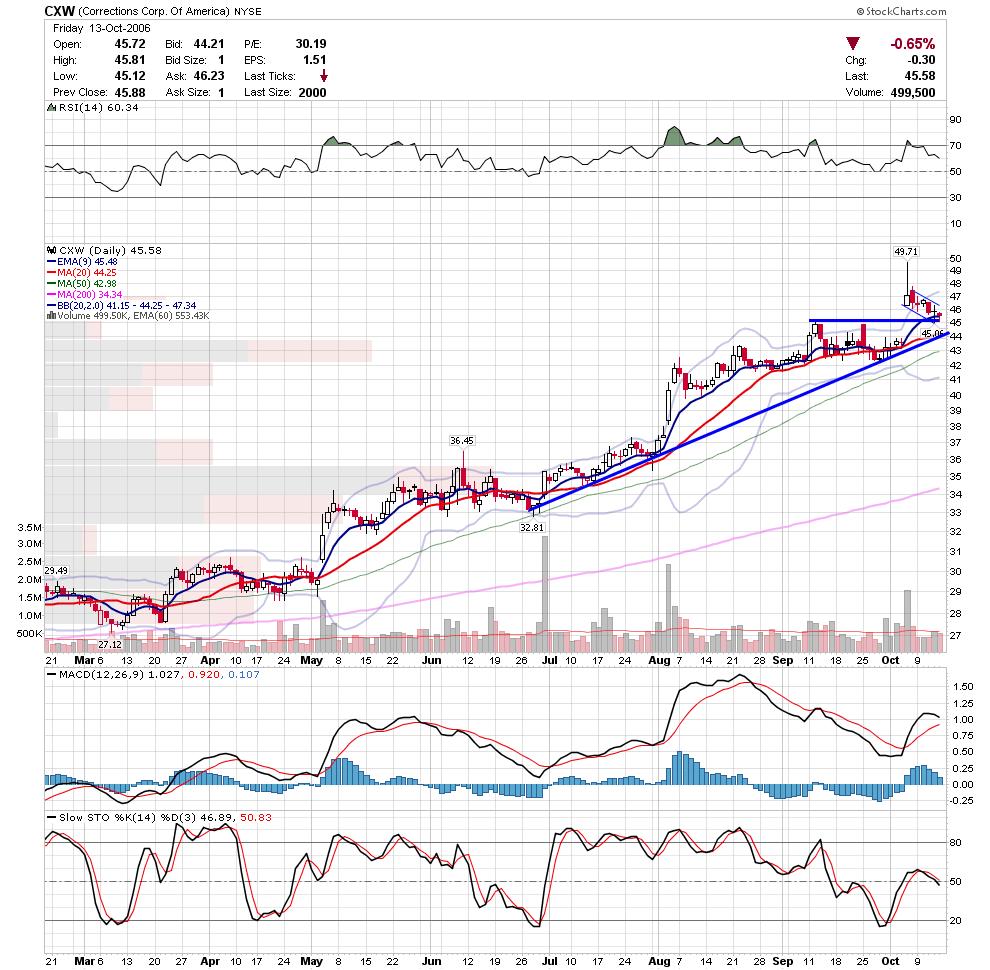
Corrections Corp. of America (Public, NYSE:CXW)
CXW had a huge gap over resistance and has now pulled back on declining volume to gap support.

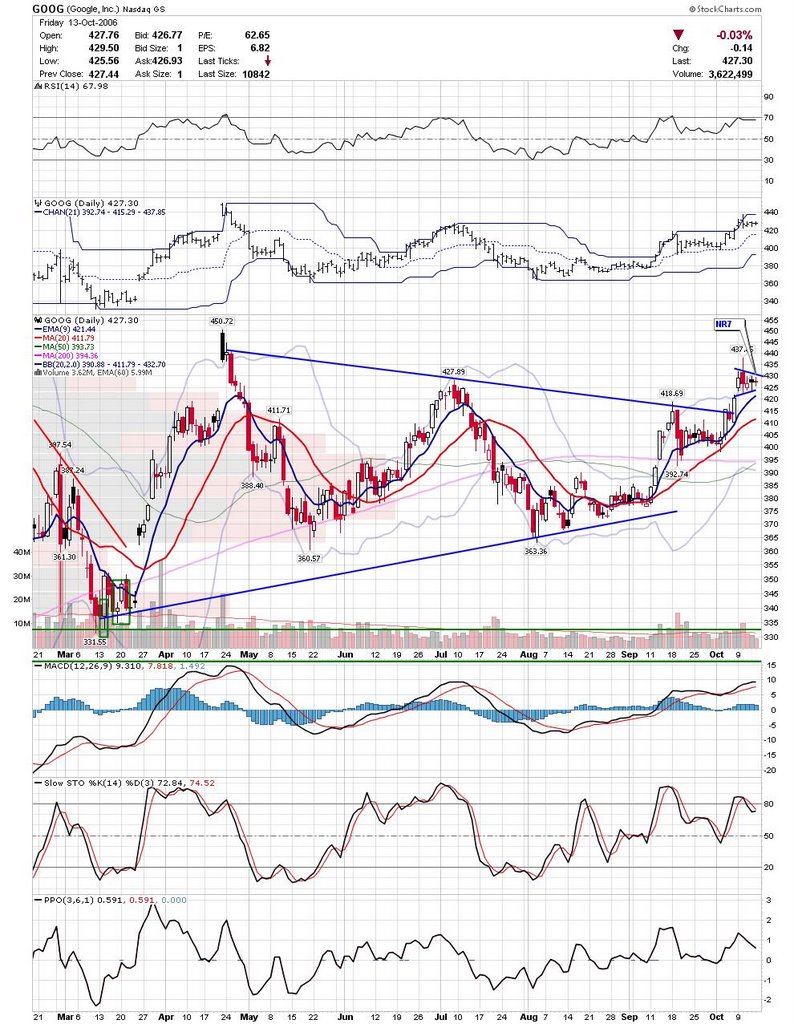
Google Inc. (Public, NASDAQ:GOOG)
GOOG cleared a triangle and is consolidating the move. It formed one of those NR7's that Tradermike loves and should be close to making a move.

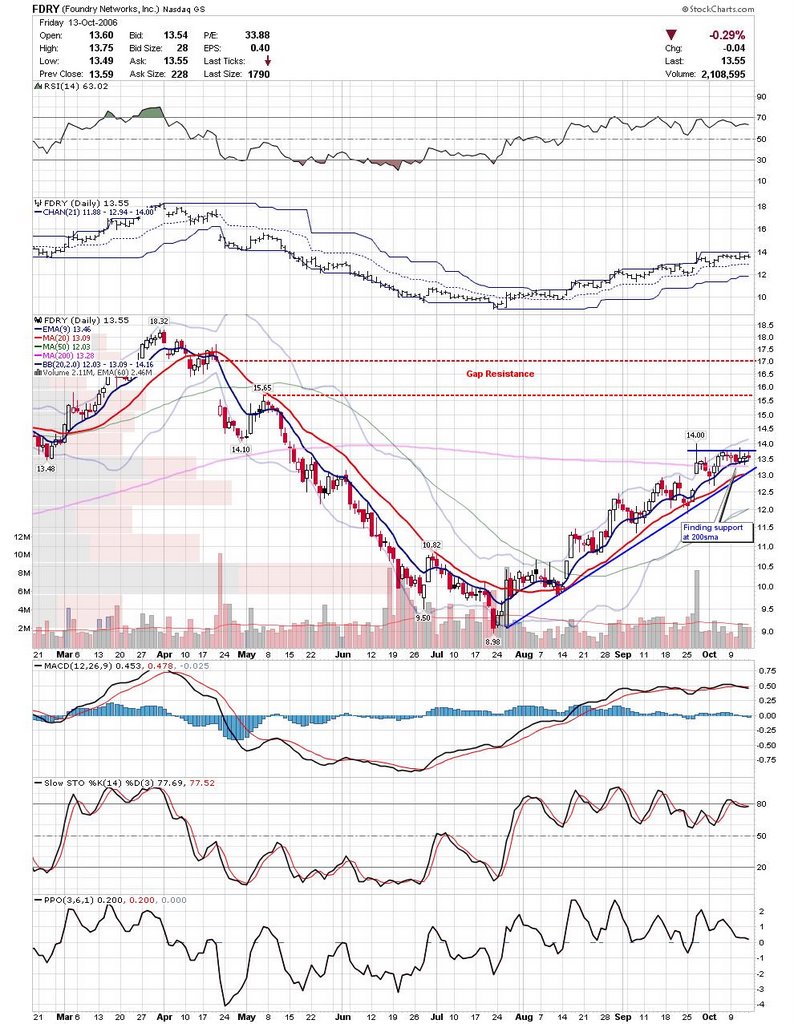
Foundry Networks, Inc. (Public, NASDAQ:FDRY)
FDRY is hugging the 200sma as support and may make a frantic push towards gap resistance. It is looking quite extended on the weekly chart, but sometimes stocks have a way of running longer then anyone expects.

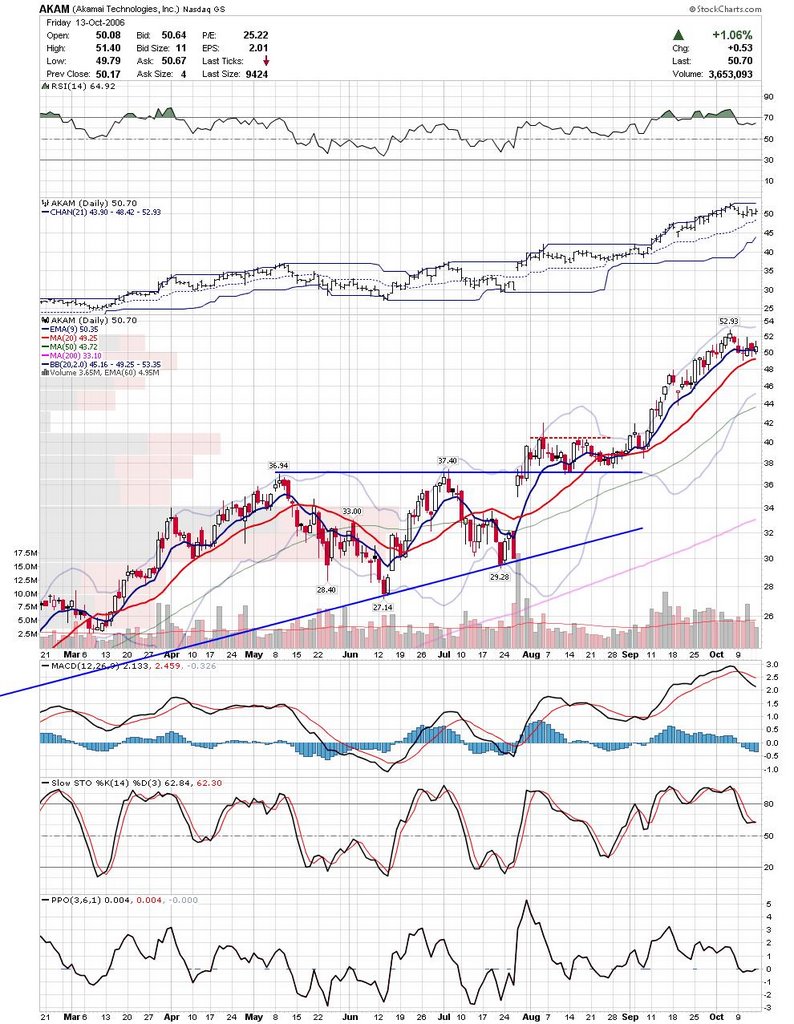
Akamai Technologies, Inc. (Public, NASDAQ:AKAM)
AKAM is making the first trip to the 20sma since it's breakout. This is usually a decent entry for those that missed the party. It looks like it may need a little more consolidation, but could move early if markets get another strong push.

As the indices keep pushing higher, it is important to keep things in perspective as to where we stand in the large picture. The indices are overbought, at the tail end of a 4 year bull market, in one of the most treacherous months for bulls. While it's best to trade reality and not expectations, the fact remains that this is a dangerous time to be fully leveraged. Keep your stops in place, because the dips won't be bought one of these times.

Good Luck,


DT